
Why women still don’t get it

women

As the veil of exploitation that clouds the technology industry and its treatment of women continues to unravel with the likes of Uber, 500 Start-Ups, Binary Capital and Google, all fingers point squarely at the men responsible in these organizations. However, if we are going to have a real discussion about the unbalanced representation of women, not just in technology but across every industry around the world, then we as women need to accept some responsibility for the current state of affairs.

My work is focused on leadership development and my passion is working with women. I run several women’s groups that explore the realities of organizational life. While many of the issues discussed are about better access to senior jobs, inability to create work/life integration and executive presence, the most puzzling issue is the role women play in perpetuating the mistreatment of women. The simple question of how many women have female mentors is followed by intense discussion around men being better advocates for women and the fundamental preference to work for men over women.

The stories that exist behind this preference of avoiding female leadership are similar. Female bosses are unnecessarily tough or harsh with their female employees, female bosses make assumptions and therefore do not really listen to their female employees’ needs, or most worrying, female employees look at these role models and think this is not the life they want to lead.

To be clear, this is not an issue of women against women per se. The intentions of these female leaders are likely driven to be constructive. However, they have had to survive in a man’s world, and survival breeds suffering. Alone in their battles, they had to toughen who they were, sacrifice their own needs, and change behaviours in order to survive. This constant sense of threat created behaviors that may serve them but not others well. These survival behaviors then permeate in their leadership style, and feel more exaggerated when around other women. Much like a drill sergeant in the army, these female leaders take it upon themselves to toughen the next generation for the harsh world that lies ahead. However, in this toughening process, these female leaders have inadvertently repelled women from their mentorship and worse, impact their desire to stay engaged in the traditional workforce.

The truth is, when we are required to rally against a common enemy, we unite in our goals. This topic is discussed in my earlier article Trump – the greatest gift to the underrepresented . But this fight instinct is hard to turn off for some women. Almost as though they are operating with PTSD, all the natural capabilities we know women possess due to their neurobiology including more networked and multi-tasking capabilities and better processing of sensorial and emotive information seem to play against them. In trying to preemptively teach their female employees survival behavior, they fail to meet them on an emotional level.

When our public servants like Justin Trudeau appoint a cabinet equally representative of men and women, while Theresa May appoints an all-male parliamentary science and technology committee to explore the issue of stereotypes of women in STEM, we see how this problem propagates on a geopolitical level. Why do we as women sometimes act as our own worst enemy?

The organizational implications are not insignificant. This is not simply a supply and access issue. Organizations need to pay close attention to how they support and form networks for these females employees once they are within their businesses. The question of how can organizations create the kind of environment where women can feel less threatened, more emotionally expressive and more collaborative has been overlooked for too long. Furthermore, consideration on how mentors are being selected and developed is critical. Simply being a woman in leadership should not be the only criteria in making you a role model for other women. Like wise, if as a woman, you are feeling alienated by other women, it is your job to speak out and change that pattern. Yes, men have a role to play in our underrepresentation, but so do we.
 

Trump – the greatest gift to the underrepresented

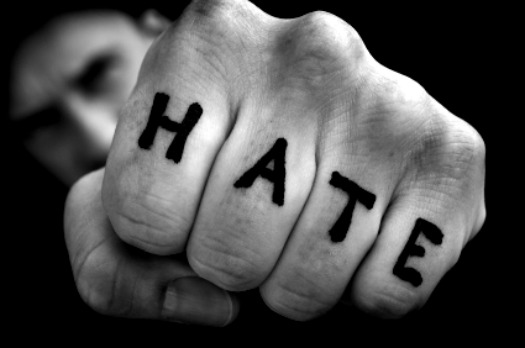
Hate

With nine months at the helm of the largest leadership position in the world, Trump continues to polarize people with the same efficacy in which he ran his campaign. Love him or hate him, he evokes such raw emotions that make ignoring him completely impossible. In a world where noise is the most prevalent message, I would argue his communication strategy delivers on all fronts as being more impactful than any mainstream media outlet.

The problem is that we are so fixated on what he says that we are missing the greatest gift he has given us – unification of like-minded people. Whether you swing Alt-Right, stand in support of the LGBTIQ communities, or fight for better rights for Women, we are all now stronger because of Trump.

Never in history have we come together as we have under his regime. De facto groups are uniting in scores because they finally get there is more power in coming together than fighting over our differences. Consider the women’s march against Donald Trump – this was the largest day of protests in US history and continues to align women all around the world. We have more people fighting against Islamophobia today when arguably, Muslim geo-political relations have never been so tense. We are holding large technology companies accountable for their blatant violation of women’s rights when before we dismissed it to the nature of the industry. This alignment of goals, the desire to stand by the underrepresented would not exist today if we did not have Trump.

The real secret to Trump’s strategy is evocation of raw emotions. Emotions have the power to completely hijack any sense of rationality, compelling us to act in ways we may not otherwise consider. Why did so many people march when they had never marched before? Why are people now advocating for diversity as if it’s a novel idea that never previously existed? It boils down to our most universal of emotions – hate. Whether you hate Trump as a leader and want to rebel against all he represents, or you hate your fellow neighbor, you now feel you have a voice to rationalize that hate. It’s through that hate that we self-organize and drive for action, in ways that our normal state of complacency would never allow us. Hate creates cortisol and cortisol makes us focus. Focus on doing things we would never normally do.

Now if we move this revolution to an organizational context, what can we learn? In my experience of organizations, they do everything in their power to avoid raw emotions. Whether its fear of an economic downturn, the depression of a recent failure or the unadulterated joy that comes from success, we try to even out the organizational sentiment into one of steady state, believing that this steadfast approach will avoid any volatility. However it is this volatility that brings us together, the deep felt emotions that binds us to take action in ways we normally wouldn’t imagine.

Therefore organizations need to ask themselves ‘do we lean into raw emotions or try to manage them’? If you are not exploiting the emotion, you are missing out on the opportunity to do great things.

The heart of creativity is volatility – how mutuality breeds innovation

Some of the greatest gifts given to this world were created through partnerships. People so deeply connected by a mission or passion, that their combined effort is what created the success story. Would we have Google today if Page and Brin didn’t come together? What about Apple without Jobs and Wozniak? Ben & Jerry’s without Cohen & Greenfield? Procter and Gamble without their namesakes?

There is no doubt that teamwork is an ideal way to build something that is greater than the individual strengths and weaknesses of a person. However the harsh reality is that most teams fail. While we have hundreds of ideas on how to make teams work better and more efficiently, I think it boils down to a much deeper, emotional connection that is felt by a few that pushes them to great heights.

Some can relate to those rare moments when we feel so deeply with another person that the world around us seems to fade away. Be it a lover, a friend, a fellow student or a random stranger – but its no surprise that these rare moments never start at work. It needs to begin in a place of raw emotional connectivity, something seldom created in a professional work environment. They are born late at night, during personal crisis, or during painful life moments. From this place of raw emotional connection, we can choose to indulge in its momentary experience, or we can push into it to see what emerges.

Most stay in this emotional place for a short time because the emotions that create them (often anger, fear, or sadness) hijack our cognitive abilities. We connect on the rawness of our feelings but rarely transcend into creation. Mutuality is what exists when you push into the expression of the emotion, to creation.

The pre-conditions for mutuality to be achieved are rare. Most stay in a place of sympathy, which means you feel for someone, OR empathy, which means you feel with someone; mutuality is feeling oneness.   Oneness with someone where there is no separation between you, the emotion and the other person. In those rare moments when oneness is achieved, we are often paralyzed with the emotional state, unable to do anything other than indulge in the feeling. Those who have been able to breakthrough the emotions, into a place of curiosity of what could be created, are in mutuality.

Creativity needs volatility to exist; innovation is what is created through mutuality. As organizations think about creating more innovative cultures, the first question to ask is ‘what do we do to support the expression of raw emotions’?

Why leadership development is broken within organizations

Never have we had more literature and research on leadership development. Every industry talks about its importance and leading organizations and academic institutions invest billions in its research. Yet, most indicators we have to measure global leadership impact are saying we are worse off today then ever before. So what’s broken? Why in a generation that values and invests heavily in its leaders, do we keep failing?

To begin unpacking this dilemma, it first requires an understanding of how these leadership programs are designed. Often filled with all-star employees who consistently out perform others within the organization, these hand selected individuals are given access to global opportunities, mountains of psychometrics tests and a plethora of leadership training and coaching.   On the surface, it sounds like the right formula for success, however, there is a key ingredient to this approach that is missing.

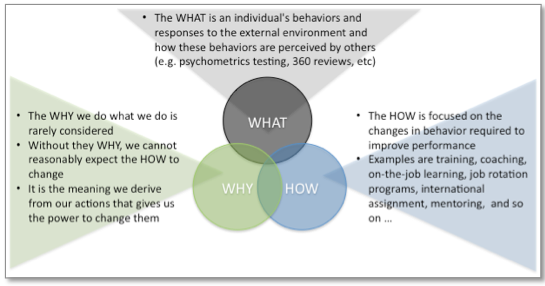
Leadership development programs typically focus on two aspects of what should be a three-pronged framework. The first element is the WHAT. These are the behaviors demonstrated by the employee. These include self-assessments, or more accurately psychometric tests and 360 feedback to better understand themselves and how others are perceiving them. These tests are incredibly valuable for better self-awareness and impact on others, however this is only one part of the equation.

The second focus of these programs is on the HOW. How do we address the limitations as identified in the psychometric tests and 360s? This often takes the form of training, executive education programs, mentoring, and executive coaches. Hands-on integration of this new found theory into everyday working life should result in substantial results, but the sad truth is that any change in behavior is short lived and most professionals revert back to their original mode of operation within a year of the intervention.

What is often missing is the WHY. Why do we behave the way we do and what is ultimately the meaning each individual attaches to the behaviors demonstrated. A metaphor I often draw on when speaking to corporate clients about the need to examine the why – is the marathon runner. A fine specimen of health and fitness, this individual has developed and fine-tuned their body to deliver a very specific result. Now put these same, near perfect specimens of health in a baseball game, they are likely to underperform. Over time, if you continue to force these athletes to use their bodies and minds in a way that is different from their training, most are likely to loose engagement.

What Why How

Much like the managers we have in organizations, employees fine-tune their skills in order to achieve a certain result. As the organization keeps changing the goal posts (e.g. the sport), we assume these managers will continue to thrive in the way they once did. What is missing is an understanding of what they want for themselves and what they are mentally prepared to work for.

By focusing on the why, or more accurately the meaning – we understand a few important things. First, we understand why these employees behave the way they do. Why do they have such high expectations for themselves? What is the series of life events that have allowed them to operate at higher levels than their peers? We also understand how they are programmed. In most cases, these employees have developed extraordinary coping skills at dealing with uncertainty, fear, anxiety and challenge. While others may crumble in the face of such odds, these employees often find themselves at their best. We often attribute this to some non-quantifiable aspect of their personality but the truth is, there is hard science behind what makes them that way.

 Ultimately, the brain forms through our life experiences. It is this formation that influences how we see and process the world around us. When wanting to create behavioral change, it implies a re-calibration of how the person sees the world and themselves within it. While in some cases, these changes may seem small, the reality is that the person is trying to reverse a lifetime of self-fulfilling views. If you spent every day of your adult life focused on being an excellent marathon runner and then one day someone tells you to be a baseball player, it’s not a simple matter of substitution of goals, but a re-examination of what your life’s journey means and how you identify with what you do.

Change is hard and impossible to optimize, but is a necessity in the world we live. Therefore organizations need to ask themselves ‘how do we help employees change on a more personal level and is that change fair to ask’?